We are starting another phase of our
CCIE Study Guide Series, with some documentation and configuration instructions on NAT-PT.
NAT-PT stands for "
Network Address Translation - Protocol Translation" it is an IPv6-IPv4 translation mechanism, which was designed (created) to allow
IPv6-only devices communicate with IPv4-only devices and vice versa.
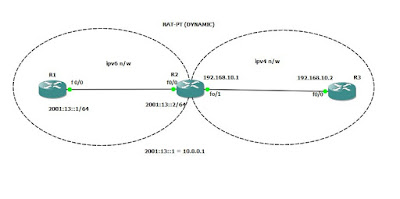
Cisco's basic operation of the NAT-PT consists of three items:
- The IPv6 only device (node) that is located on a IPv6 only network
- The IPv4 only device (node) that is located on a IPv4 only network
- And, the Cisco NAT-PT router that is located in between both network only devices and is doing the protocol translating.
NAT-PT is mainly used by organizations (companies) as a short-term fix; until they are completely ready to migrate to IPv6.
The best advantage of using Cisco's version of NAT-PT is that only the Cisco NAT-PT router needs to configured; the IPv4 and IPv6 network only devices involved are totally clueless that NAT-PT is happening between them. Cisco recommends that you never allow a Cisco NAT-PT router perform NAT-PT between Dual Stack devices.
The major downfall of using Cisco's version of NAT-PT is that you have a single point of failure, the Cisco NAT-PT router itself. This is why Cisco recommends that the NAT-PT solution only be used for a short amount of time, until a long term solution can be achieved.
Currently, Cisco NAT-PT can be implemented in four ways:
- Static NAT-PT
- Dynamic NAT-PT
- Port Address Translation (PAT) a.k.a. Overload
- IPv4-Mapped Operation
While we prepare some detailed configuration instructions on the above methods, please do not forget to checkout the earlier study notes that we have prepared for
CCIE.